Founding of Shiloh School & Meeting House
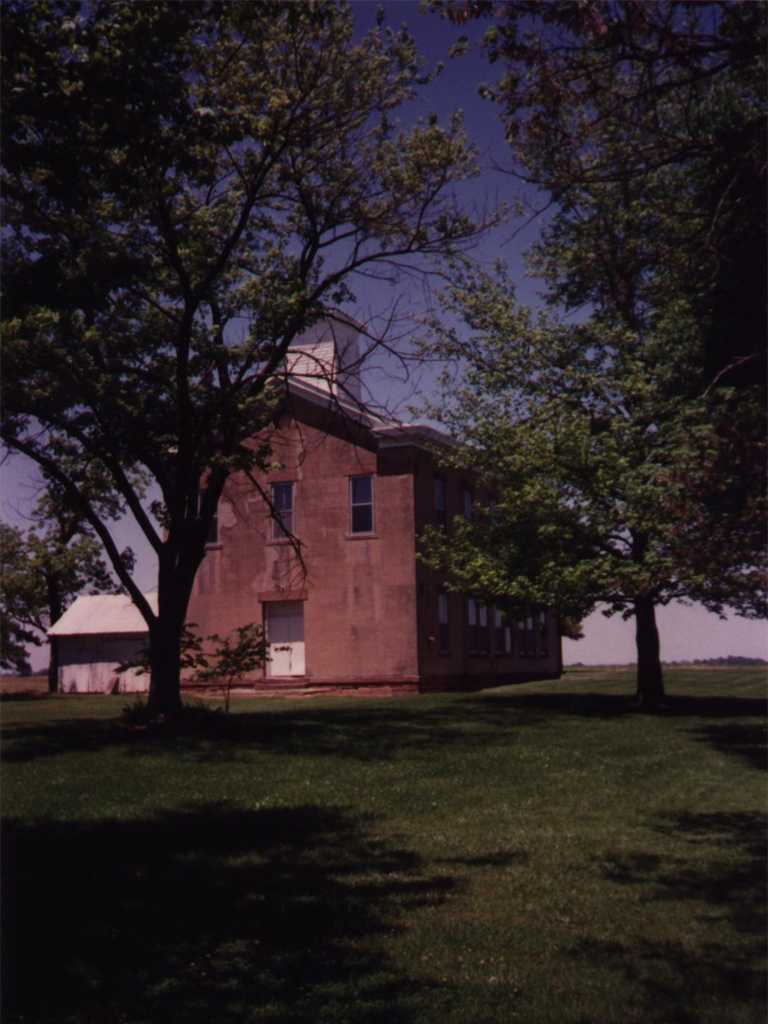
Shiloh School District & College
Randolph County, Illinois
Location
N.W. quarter of the N.E. quarter of Section 14, Township 7 South, Range 5 West
Randolph County, Illinois
Citizens of Randolph & Jackson Counties met at the house of John B. Burke to draw articles of agreement for building a school house and meeting house.
Building Specifications
- Dimensions: 26 feet length × 20 feet width, one story high
- Construction: Well-hewn timber walls, raftered and covered with 3-foot boards
- Features: Stone chimney, plank floor, two doors, plank shutters
- Windows: Two windows with sash and glass
- Finishing: Cracks stopped with lime mortar
- Additional: Well to be dug and walled
Completion Deadlines
- Wall, roof, floor, and doors: April 1, 1836
- Well: July 1, 1836
- Chimney: October 1, 1836
Original Trustees
Usage Policy
Free for all Christian denominations. When multiple appointments occur on the same day, the first or oldest appointment has use of the house until 1:00 PM, and so on until all are served.
Original Subscription List (1836)
| Subscriber Name | Amount ($) | Subscriber Name | Amount ($) |
|---|---|---|---|
| James Gillespie | 10.00 | William Gwin | 5.00 |
| John B. Burke | 10.00 | B.F. Bradley | 4.00 |
| Abel Broughton | 5.00 | David Sterns | 5.00 |
| James H. Bradley | 8.00 | R.G. Davis | 5.00 |
| William Pike | 5.00 | Jane Smith | 3.00 |
| John Barrow | 10.00 | Harvey McNeill | 5.00 |
| Daniel Barrow | 1.00 | Daren Houseman | 5.00 |
| Ireby W. Stone | 5.00 | Arthur Cross | 2.00 |
| Emanuel Canaday | 8.00 | James Steele (sen) | 2.00 |
| Tanner Briggs | 1.00 | Francis S. Jones | 2.00 |
| Gabriel Jones | 2.00 | George Thomerson | 2.00 |
| Step Wise | 1.50 | William Lyon | 1.00 |
| R.A. Bradley | 3.00 | John Short | 1.00 |
| A.F. Kilpatrick | 1.00 | Isaac B. Brown | 1.00 |
| Mr. Morrow | 1.00 | Archibald Steele | 1.00 |
| George Steele | 1.00 | David Steele | 1.00 |
| C.T. Jones | 2.50 | Francis Steele | 1.00 |
| Jeremiah Murphy | 1.00 | James McCormick | 1.00 |
| F. Swanwick | 1.00 | R.C. Jones | 2.00 |
| TOTAL: | $129.00 | ||
First School Session
Started: April 4, 1836
Teacher: Josiah Culley
Duration: 9 months
Enrollment: 20 scholars
Land Purchase for Shiloh (1839)
Citizens agreed to purchase 80 acres of land from Congress, including the Shiloh School and Meeting House, for the general benefit of inhabitants of both Randolph and Jackson Counties.
Entry Details: James Gillespie and John B. Burke traveled to Kaskaskia, where James Gillespie entered the land in his name.
Land Purchase Subscribers
| Subscriber Name | Amount ($) | Subscriber Name | Amount ($) |
|---|---|---|---|
| James Gillespie | 10.00 | William McNeal | 2.50 |
| John Barrow | 10.00 | Robert Looney | 2.50 |
| John B. Burke | 10.00 | Daniel C. Lynch | 2.50 |
| Arthur Cross | 5.00 | William Bradley | 2.00 |
| Abel Broughton | 5.00 | James Barrow | 2.00 |
| Josiah Culley | 3.00 | James H. Bradley | 5.00 |
| John H. Burke | 1.25 | Benjamin F. Bradley | 5.00 |
| George Pike | 2.50 | T. Briggs | 1.00 |
| I. W. Stone | 1.00 | T.C. Burke | 1.00 |
| Jabes B. Newton | 1.00 | W. B. Malone | 1.00 |
| William Duff | 2.00 | J. Finey | 1.00 |
| John Moore | 2.00 | J. A. Lightfoot | 1.00 |
| Harvey McNeal | 5.00 | J. W. Gwin | 1.00 |
| Richard A. Bradley | 3.50 | E. Canaday | 5.00 |
| Joshua Bradley | 2.00 | James McLaughlin Jun. | 1.00 |
| John M. Gillespie | 1.25 | ||
| TOTAL: | $101.75 | ||
Shiloh College Incorporation Charter
Charter Approval
Approved: January 8, 1840
Recorded: March 22, 1840
Speaker of House: Wm. L. D. Ewing
Speaker of Senate: S.H. Anderson
An Act to Incorporate Shiloh College
Section 1: Incorporation
Enacted by the people of the State of Illinois that James Gillespie, James H. Bradley, John Moore, Benjamin F. Bradley, John Barrow, William Pike, Richard A. Bradley, and John B. Burke are hereby created a body incorporate and politic by the name and style of the "President and Trustees of Shiloh College" with perpetual succession. The institution is designed to promote the cause of education and improvement of literature, located in Randolph County.
Section 2: Powers
The Corporation shall have power to:
- Make and execute contracts for promoting education and literature
- Purchase and hold personal property as needed
- Purchase and hold land not exceeding 80 acres
- Sue and be sued in its corporate name
- Have a common seal
- Make by-laws not inconsistent with U.S. or State Constitution and laws
Section 3: Governance
A majority of Trustees shall form a quorum and have authority to:
- Elect a President and other officers
- Prescribe courses of study
- Fix tuition rates
- Appoint a Preceptor and necessary assistants
Section 4: Vacancies
A majority of the Board may fill vacancies occurring from death, removal, resignation, or otherwise.
Section 5: Religious Freedom
The institution shall be open to all religious denominations, and no particular religious faith shall be required of officers or pupils.
Original Board of Trustees (1840)
◆ Historical Significance
Shiloh College holds a notable and arguably unique place in the educational history of Illinois. When the Illinois General Assembly chartered it on January 8, 1840, the institution's founding document contained a provision that set it apart from every other college then operating in the state: "The institution shall be open to all religious denominations, and no particular religious faith shall be required of officers or pupils."
This clause was not merely a formality. The colleges that preceded Shiloh in Illinois — among them Illinois College (founded 1829 by Presbyterian missionaries) and McKendree College (founded 1828 by pioneer Methodists) — were each established under the sponsorship and governance of a specific religious denomination. Their charters reflected sectarian origins, and their character and instruction were shaped accordingly.
Shiloh, by contrast, was organized by the citizens of Randolph and Jackson Counties without denominational sponsorship or ecclesiastical oversight. Its founders were drawn from multiple Protestant traditions and sought a common institution that would serve the broader community rather than any single church. The 1836 meeting house that preceded the college had already operated on the same principle, offering its facilities equally to all Christian denominations.
On this basis, Shiloh College may reasonably be described as the first independently chartered, non-sectarian college in Illinois — an institution founded on the principle that higher education should be governed by its community rather than by any church. The Randolph County township history recorded it simply as "the first college in Illinois," a claim that, while unqualified, reflects local pride in a genuine distinction.
Note: This characterization is supported by the language of the 1840 charter and by comparison with the histories of contemporaneous Illinois colleges. A definitive scholarly determination of precedence awaits further archival research.
Elections & Administrative Records
Election Results:
Trustees: J. Gillespie, J. Barrow, J.B. Burke (re-elected)
Clerk: Josiah Culley
Judges: Ireby W. Stone, John Creath, Emanuel Canaday
Election Results:
Trustees: John Barrow (9 votes), James Gillespie (9 votes), John B. Burke
Clerk: Josiah Culley (8 votes)
Judges: Abel Broughton, Emanuel Canaday, David B. Duncan
Election Clerk: Ireby W. Stone
Election Results:
Trustees: George Pike (teacher), John Moore, John Barrow, James Gillespie
Clerk: Josiah Culley
Election Results:
Trustees: James Gillespie (9 votes), James H. Bradley (9 votes), John Moore (7 votes)
Secretary: George G. Pike (4 votes)
Judges: Arthur Cross, Benjamin F. Bradley
Election Results:
Trustees: James H. Bradley (3 votes), Ireby W. Stone (2 votes), James Gillespie (2 votes)
Clerk: Thomas C. Burke (3 votes)
Judges: Daniel C. Lynch, William G. Murphy
Election Clerk: Ireby W. Stone
College President Election:
Chairman: John Moore
First Ballot: John Barrow (3), James Gillespie (3), John B. Burke (1), John Moore (1)
Second Ballot: John Barrow (5), James Gillespie (3)
Result: John Barrow elected President
Secretary: T.C. Burke (4 votes) defeated Ireby W. Stone (3 votes)
Election Results:
Trustees: John B. Burke, John Barrow, Harvey McNeill (won drawing against James Gillespie)
Clerk: Claiborn Barrow
School Directors Election:
Emanuel Canaday (36 votes), H. McNeill (36 votes), M. Swartzop (36 votes)
Other candidates: Jeptha Glore (21), J.R. Burke (10), James Bradley Jr. (3)
School Directors Election:
M. Swartzop (9 votes), James Bradley Jr (9 votes), Emanuel Canaday (9 votes)
Historical Timeline
Meeting at John B. Burke's house to establish Shiloh School & Meeting House
Construction commenced
First school session began with teacher Josiah Culley and 20 scholars
Citizens petitioned Randolph and Jackson Counties for formal school district establishment
Well digging project initiated (4.5 feet diameter, 40 feet deep)
80-acre land purchase subscription initiated; $101.75 raised
Daniel C. Lynch commenced 12-month school session
Citizens convened to petition for incorporation as Shiloh College
Shiloh College charter approved by Illinois General Assembly
Trustees ordered deed preparation for land transfer from James Gillespie
Deed received; T.C. Burke elected Clerk; charter ordered to be recorded
Charter officially recorded
John Barrow elected first President of Shiloh College
Citizens subscribed $93 for Claiborne Barrow's school
Board rules established for governance and meeting procedures
Trustees appointed school directors for M.W. Doggett's school session. Quarterly meeting schedule established (April, July, October, January)
Notable Teachers
| Teacher | Start Date | Duration | Notes |
|---|---|---|---|
| Josiah Culley | April 4, 1836 | 9 months | First teacher; 20 scholars |
| Daniel C. Lynch | April 1839 | 12 months | Continued teaching through 1840 |
| Daniel C. Lynch | January 6, 1840 | 12 months | Second term |
| Claiborne Barrow | August 15, 1842 | — | Also served as Clerk |
| M.W. Doggett | c. 1850 | — | School session mentioned in 1850 records |
Board Rules (Established May 20, 1848)
Rule 1: Presidential Powers
The President shall call the house to order, keep the same, announce readiness to proceed to business, take votes on all questions, and in case of a tie, give the casting vote.
Rule 2: Question Handling
All questions or resolutions shall be taken up and disposed of in rotation as they are offered in writing or verbally.
Rule 3: Speaking Order
Only one member may speak at the same time.
Rule 4: Amendments & Voting
All propositions offered shall be subject to amendment. Votes shall be taken separately by ayes and nays.
Rule 5: Voting Requirements
Every member is required to vote on all questions at the request of any member.
Rule 6: Meeting Convocation
The Board may be convened at any time upon request of any three members by giving ten days notice through the Secretary's advertisement.
Meeting Schedule
Quarterly meetings: First Saturday of April, July, October, and January at 12:00 PM
Attendance Policy
Members failing to attend quarterly or special meetings without lawful excuse shall be fined between $0.50 and $2.00, at the Board's discretion. Fines shall be under the control of the Trustees of Shiloh College.