St. John's "Post Oak"
Lutheran Church
Campbell Hill, Jackson County, Illinois
History of the Congregation
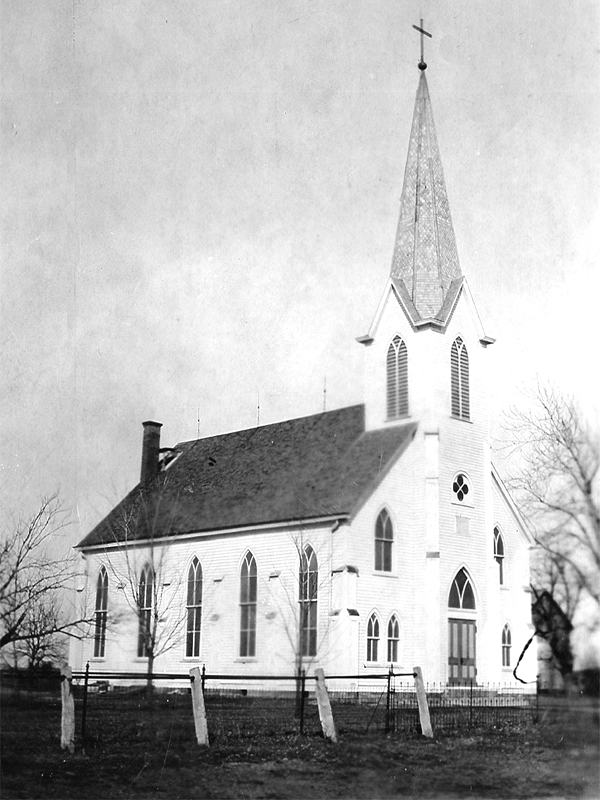
Campbell Hill, Illinois
Photo courtesy of David Inlow
The German Lutheran settlers of Bradley Township left no formal record of how they decided to organize a congregation, but by 1864 they had invited Pastor J. F. Hornberger, who served the nearby congregation at Wine Hill, to come every other Sunday to preach and administer the sacraments. He did so at Schneider's Schoolhouse, not far from what had been Barrow School. From the beginning the congregation was known as St. John's, though it became nearly as well known as "Post Oak," a name drawn from the great grove of post oak trees in which the buildings stood. For a time St. John's and St. Peter's at Wine Hill shared both a pastor and a schoolteacher, an arrangement that continued at least through the tenure of Pastor Richter.
About 1864 William Schutte donated a parcel of land, and as the community grew a second adjoining parcel was added in 1872, bringing the total holding to ten acres. The first building was erected in 1873 just west of where the present church stands, serving as both house of worship and schoolhouse for thirty-one years. The level ground to the northwest was set aside as a cemetery; as that area filled, a second "new" cemetery was established to the northeast of the church.
The final decade of the nineteenth century brought new additions to the property. The parsonage was built in 1891, replacing an earlier two-room log house on the same site. The following year the congregation purchased the large bell still in use today; as the present steeple did not yet exist, a small temporary structure was built beside the church to house it.
In August 1904 a windstorm damaged the building and the congregation voted to build anew. The present church stands to the east and north of the old one, oriented north to south with its entrance facing the road. The cornerstone was laid 5 June 1905 and the dedication held 22 October 1905, drawing some three thousand people.
St. John's belonged to the Wartburg Synod of Illinois, an association of German Lutheran congregations formed to preserve their language, liturgy, and confessional identity. Services were conducted entirely in German for generations. The transition came slowly — by the Second World War the congregation was holding only one German service each month — and the last German service was held in 1967.
Founding Members — 1864
Families and individuals who organized the congregation at its founding in 1864, drawn from the original church records.
Search All Records
Searches baptisms, confirmations, marriages, and funerals across all records. Partial names match — type Gue to find Guebert, Gübert, etc. Click any result to open that record page.