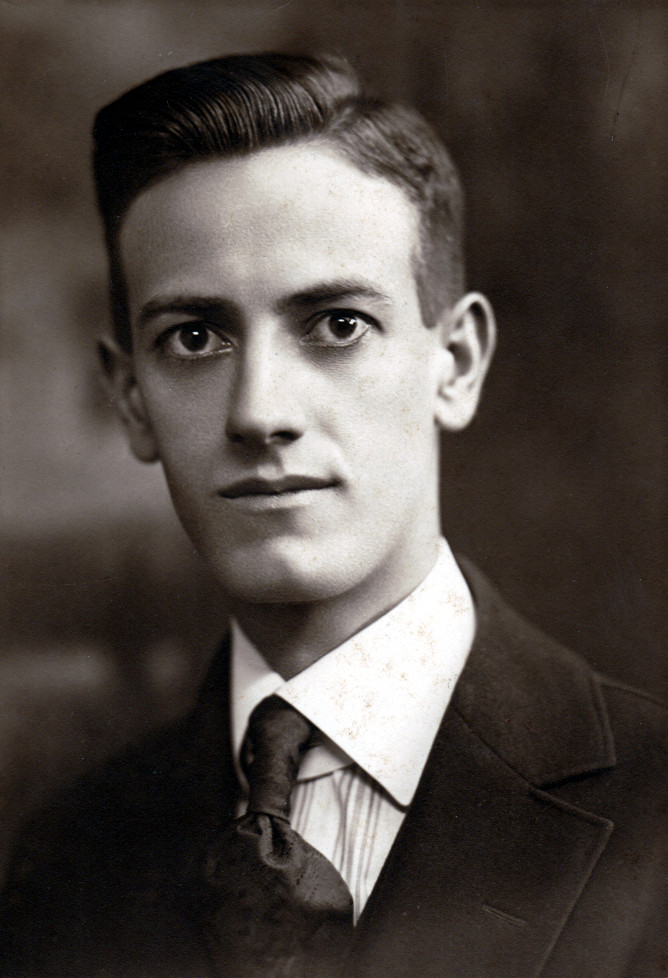
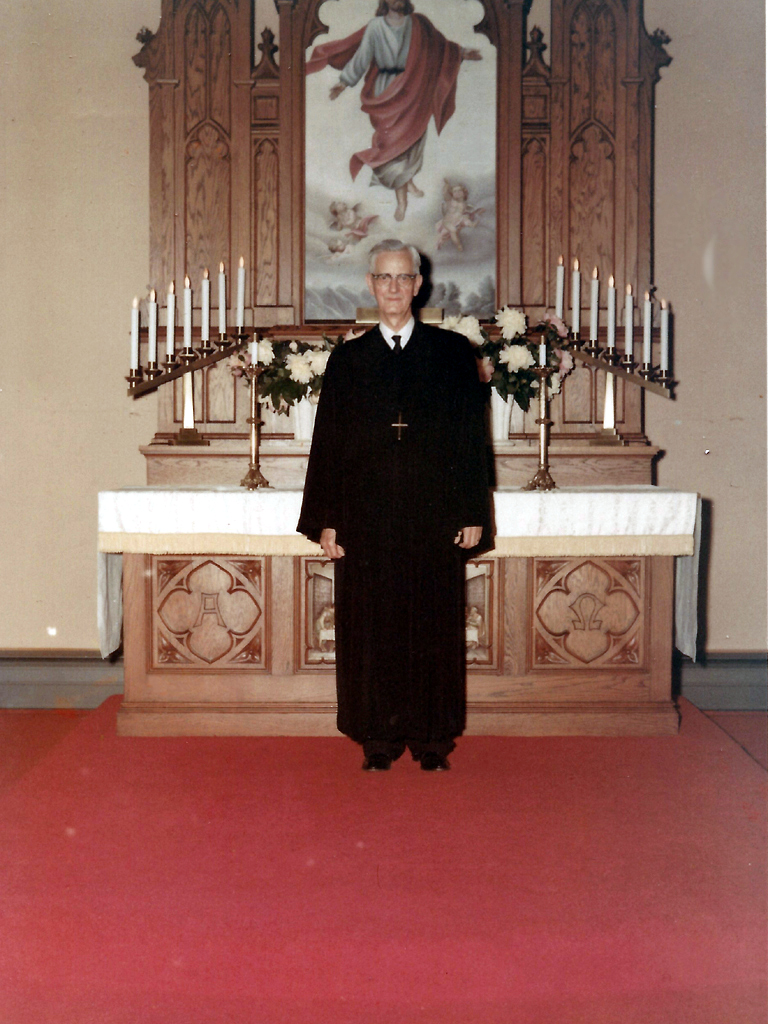
Harry C. Welp was born on 12 August 1897 in Frohna, Perry County, Missouri, the son of Henry J. Welp and Regina Twenhafel. Frohna was a close-knit German Lutheran settlement in the Missouri Ozarks, and faith in the Welp household was not merely observed but practiced professionally — Harry's father was the teacher and principal of the Christian Day School at Trinity Lutheran Church, where all the school-age children of the community were enrolled. At the age of six Harry took his seat in his father's two-room schoolhouse, and eight years later he graduated from it.
The ministry had been his aim from boyhood. "My desire was, with the help of God, to prepare myself for the Holy Ministry," he wrote late in life. In the fall of 1911, at the age of fourteen, he left Frohna for St. Paul's College in Concordia, Missouri. His parents would wait ten years from that day for the morning they watched him ordained.
Harry graduated from St. Paul's College in 1917 and enrolled at Concordia Seminary in St. Louis — an institution of nearly 600 students taught by eleven professors. His graduating class numbered 84.
His vicarage year, served in 1919 and 1920, placed him at St. John Lutheran Church in Baldwin, Illinois. His duties were broad: teaching the Christian Day School through all eight grades, leading youth work, assisting the pastor with preaching, and performing other pastoral duties as needed. Each summer during his seminary years he traveled to Indianapolis to work — the first summer at the Stutz Automobile Factory, which built one car per week; the following summer at the Pres-O-Lite Company. It was in Indianapolis, in the summer of 1919, that he met the woman who would become his wife.
Alma Rafert was working at Kingans in Indianapolis when she and Harry first crossed paths in the summer of 1919. The timing left precious little room for courtship.
It was while I was working at Kingans that I met Harry, it was the summer of 1919. He was in Seminary in St. Louis, but during the summers he worked in Indianapolis at the Stutz Motor Company. We didn't meet until two weeks before he had to go back to St. Louis so we had a date each night. He practically proposed then already, but students were not allowed to be engaged while at the Seminary. Letters came often and I now appreciate them so much more since I know how he dreads to write letters.
Harry returned the following summer of 1920, working at Pres-O-Lite. The letters continued through his final year at the seminary. Alma attended his Baccalaureate Service in St. Louis at Holy Cross Lutheran Church, and traveled with him afterward to Frohna to meet his parents. When he was ordained at Campbell Hill on 26 June 1921, she was not present — she could not get the time from work, nor did she have money for the journey. She had planned to work a full year longer. But once Harry was settled in Campbell Hill, he wanted her sooner. And so in October, as she put it simply, they had a very simple wedding.
After graduating from Concordia Seminary in 1921, Harry accepted a call to St. Peter Lutheran Church at Campbell Hill, Illinois. The town's population stood at about 250. There was no electric power line, no improved road leading into it. Four members of the congregation owned an automobile. Four churches served the community: one Southern Baptist, one Presbyterian, and two Lutheran — one LCMS, one LCA. Most people who required a hospital had to travel roughly 100 miles to St. Louis.
The congregation of about 120 souls was predominantly German-speaking. But the years since 1917, when America had entered the war against Germany, had left deep wounds. Harry described what his predecessors had faced:
A spirit of hatred developed against the German speaking people. Such was the case in the communities surrounding Campbell Hill. "Mobs" were formed who wanted the German language outlawed in all public places, such as churches, Christian schools, and business places. Even private homes were entered and given notice to no longer use the German language. The transition from the German language to the use of the English language brought on disunity among the membership of St. Peter's congregation. Rev. Ernst Hitzemann, who faithfully served the congregation for 10 years, initially refused the change to English. It was only after a "mob" threatened to tar and feather him that he agreed. For the sake of peace in the communities it was deemed wise to discontinue the use of the German language in the church services for the time being. The Christian Day School was closed. Shortly afterward, in 1919, Rev. Hitzemann accepted a call to another congregation. After some time Rev. E. Scharlemann accepted a call to St. Peter, but he remained only 18 months. The rift in the congregation was not healed.
On 26 June 1921, Harry was ordained and installed as pastor of St. Peter Lutheran Church by Rev. J. Lohrman of Baldwin, Illinois. Pastor Haertling of Christ Lutheran Church in Jacob, Illinois assisted. Harry's parents and his sister Theresia came from Frohna for the service — they had waited ten years. The service was well attended. That same day he performed his first baptism as pastor. The following Sunday he preached his first sermon, and that same afternoon conducted his first funeral.
On Labor Day 1921, the Christian Day School — closed for several years as a casualty of the wartime antipathy toward German-language institutions — was reopened. Enrollment stood at 18 pupils across all eight grades. The pastor was their sole teacher.
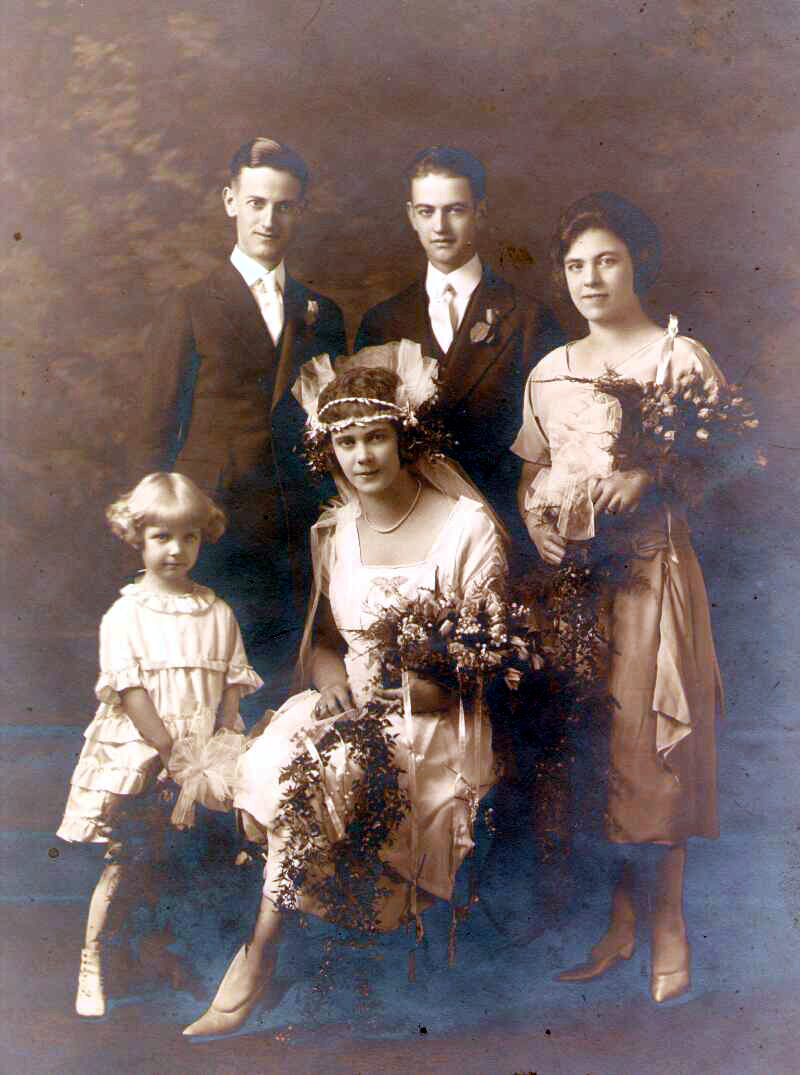
Indianapolis, 12 October 1921
Front l–r: Erna Hussmann (flower girl) · Alma · Edna Rafert (bridesmaid)
12 October 1921 remained, in Harry's own words, a special day for the rest of his life. The wedding took place at Alma's home in Indianapolis. Rev. E. Zimmerman officiated; Walt's wife Edna played the wedding march; Walt gave the bride away; Alma's sister Edna was her bridesmaid; Harry's brother Erich stood as best man; his niece Erna Hussmann was flower girl. The members of the Semper Idem Club, of which Alma was a member, watched the proceedings from the porch of her mother's house. That night they stayed at the Sheridan Hotel on Meridian Street.
The journey to Campbell Hill began the following morning. From Indianapolis they took a passenger train to Union Station in St. Louis, waited several hours for their connection, then rode four hours to Wittenberg, Missouri — a village of perhaps a hundred people. From there, the only way to Frohna was seven miles by horse and surrey. The livery owner was asleep when they arrived. He agreed to take them, and the ride took about an hour.
They reached Harry's parents' house after midnight to find every door locked. Harry noticed the trellis his father had built on the north side of the house for flowers — the flowers had been brought in for winter, and the window above was unlocked. They climbed in. In the study there was a folding bed. They opened it and slept. In the morning Harry's father came quietly downstairs, opened the door, saw them, closed it gently, and went back up to tell his wife. "It didn't take long before things were stirring in the kitchen." Breakfast was fried eggs and country ham, the conversation in German — which Alma handled with the German she had learned in her own Christian Day School at home. The young people of Frohna held a reception in the yard.
After a day or two they made their way back by surrey to Wittenberg, by train to St. Louis, and then aboard the Accommodation of the G.M.O. to Campbell Hill, arriving at eight in the evening in the dark. Alma tells the rest:
Arriving at the Campbell Hill Station quite a few curious people had gathered. No street lights! The trainman dumped my trunk off in front of us, and I envisioned my cut glass vase in fragments. But it was ok. Mom had wrapped it in a blanket. Mr. Bentfeld was there to meet us on foot with a lantern and flashlight. We were to spend the days with the Bentfelds until our furniture would arrive. Mrs. Bentfeld was one of the truest and finest persons that I ever met. How I admired her straight-forwardness and quiet advice. For supper that evening we had homemade bread, cheese, peaches, and coffeecake. Later that evening Louis Bentfeld and Martha went with us to see the parsonage. With the flashlight and much giggling we went.
The coal burning stoves and I didn't get along well. At home my brothers took care of the stoves and of carrying in coal buckets. Often when Harry came from school the fire in the stoves was out or going too hard. All water had to be carried in from outside and the dirty water taken outside. Harry made the fire in the school building each morning. Once a week he had to clean the soot from the long stove pipe that reached across the school room. So he'd get on the ladder and I tried to keep part of the pipe from falling with a broom which I held against the pipe. What a mess!
My first Christmas Eve at Campbell Hill was a lonely one. We went to the program at the church and we had a tree at home. Coming home from church, Harry immediately had to study his sermon for the next morning. I sat in the rocker, no gifts; our package from home had not yet arrived. My gift for Harry was in the package and he had been too busy to get me one. So I rocked and tried not to think of home and the Rafert family all gathered around the Christmas tree. Two days later the package came and Harry found time to go get me a box of candy. The next year we had Phyllis and it was better.
Seven children were born to Harry and Alma in the parsonage at Campbell Hill across the years that followed. Two did not survive childhood, and the weight of those losses ran through the family's life like a current beneath everything else. Alma wrote of each child in turn, in her own hand:
Phyllis was born on October 15th, 1922 while her Dad was preaching in church. Her sister Marian followed on August 16th, 1924. Marian had beautiful brown eyes like her father and was a happy child with a quiet humor. Paul was born on March 7th, 1926; he was such a contented baby and quite active. Before he was nine months old he was pulling himself up to chairs and standing on his shaky legs. He became ill suddenly with Secondary Meningitis, a high fever set in and he was soon in a coma. He lay that way three days when the Lord called him to himself on Dec 18th, 1926. The Christmas tree was already in church at his funeral. Wrapped gifts from Indianapolis had already arrived.
Doris was born in 1927, when small she was satisfied to play alone. The neighbors remarked how little attention she asked for. In the late summer of 1929 both Marian and Doris got whooping cough, and it was terrible. Marian would run to the porch and hang on tight to the post and oh how she coughed! She was so weak after each attack. After that she never had the same pep, she was so tired. On February 1st, 1930 she contracted bronchial pneumonia; she weakened and died on February 10th.
Vera was born a few months later; she was so tiny as a child. She walked at nine months, walking right under the dining room table. When Vera was two she became desperately sick with Summer Complaint, a dreaded thing at that time. The doctor came to see her every day. The fear of losing her so soon after Paul and Marian was almost overwhelming, but God heard our prayers. Vera had to learn to walk all over again, but after that she was fine.
Ruth was born in 1932, she was a very pretty baby and her sisters loved her so. She evidently was nervous as she cried so much, in church she just sobbed while the organ was playing. But I never had to leave church because of her. When she was three years old the mumps were around and she became desperately sick with a high fever. The doctor thought mumps just came out on one side and went inside the left ear. We were afraid of losing her, but on the 10th day her ear opened with a terrible discharge and then she was fine. Mom Rafert had made her a bright red spring coat and we all were delighted when we got to take her out, she needed the color.
Tom was born in 1937, all of us were so proud to have a boy. He was so thin and the girls thought themselves so tall and said Tom would grow up to be a shrimp, but he grew to become a big man. He caused little trouble when small and played with two imaginary friends Bobey and Docker. He tinkered around a lot with wheels and wagons and made his own contraptions, they always worked.
Wrapped gifts from Indianapolis had already arrived."
When Harry reopened the Christian Day School on Labor Day 1921, he was doing more than filling empty desks. The school had been closed as a direct casualty of the wartime antipathy toward German-speaking communities, and its reopening was an act of congregational healing as much as education. All eight grades, one teacher, 18 pupils.
By 1937 enrollment had grown to 59 students — during the depths of the Great Depression, when the Synod was carrying more than 100 ordained candidates who had no congregation to call them. When St. Peter's enrollment exceeded 50, the congregation decided to engage one of these men:
Arnold Schneider of Lenzburg, Illinois was willing to head our appeal. His monthly salary was $25 and room and board. Arnold worked diligently and faithfully in our midst for eight months. The Lord signally blessed his labors in our midst. Later he became a missionary to Brazil, South America.
The school photographs from 1937 and 1938 in the photograph collection show the congregation's children in those years — Vera and Doris Welp appear in both. In 1941 Harry confirmed his own daughter Doris and her classmates, a moment preserved in the confirmation photograph from that year.
At 2:58 in the afternoon on Wednesday, 13 November 1951, a tornado swept out of the northwest and cut through the heart of Campbell Hill. It lasted three minutes. In that time it carved a path a mile long and 600 feet wide through a town whose entire population was 336 people. Fifteen homes were flattened, eight businesses damaged, two automobiles crushed. Approximately 150 residents were left homeless. Seven were hospitalized. Damage was estimated at $200,000.
The Du Quoin Evening Call reported the scene the following morning. National Guardsmen from Murphysboro arrived before nightfall to patrol the streets. A Salvation Army field kitchen set up at the intersection of Main Street and Route 43 handed out food to refugees and rescue workers. The American Red Cross sent 150 cots to the school gymnasium for the fifty or sixty displaced families. The town had no electricity and most of its telephone service was gone.
Pastor Welp went out into the wreckage as soon as the storm had passed. He came upon a woman who was trapped in her basement, unable to get out. He stayed with her, talking with her, keeping her calm, until rescuers arrived to free her. The names most associated with basement rescues in the newspaper account are those of families already known to him from the congregation and the school: the Misselhorns, the Ratherts, the Alms family. Martin Alms, 78, and his wife Lula were among the injured that day.
It was not the kind of pastoral act that makes a church record. But in a town of 336 people, where Harry Welp had baptized the children, confirmed the teenagers, married the young couples, and buried the old, there was no one better suited to sit near the ruined building and wait with someone who was frightened.
During World War II, the United States military established a network of prisoner of war camps across Illinois to house the hundreds of thousands of German soldiers captured in North Africa and Europe. One of these, Camp Pomona (an old CCC camp) was located in the southern part of Jackson county, operating as a branch camp under Camp Ellis near Peoria. The camp was only open for one season in 1945, the prisoners working on nearby farms.
The United States Army, operating under the Geneva Convention, was required to provide for the religious needs of prisoners of war. For the German Lutherans at Camp Pomona, the solution was near at hand: the government asked Harry Welp, the pastor at Campbell Hill, a fluent German speaker raised in a German Lutheran household, to preach for the prisoners.
The assignment carried a particular weight of history. Harry had watched his own congregation be torn apart during World War I by the hatred directed at German speaking communities, his predecessor threatened with tar and feather, the German language outlawed from the very church Harry now served. A generation later, he was standing before young German soldiers in a prison camp in his own county, preaching to them in the language of his childhood. Whatever those services meant to the men in that camp, they were also, in some sense, a closing of a circle that the first war had broken open.
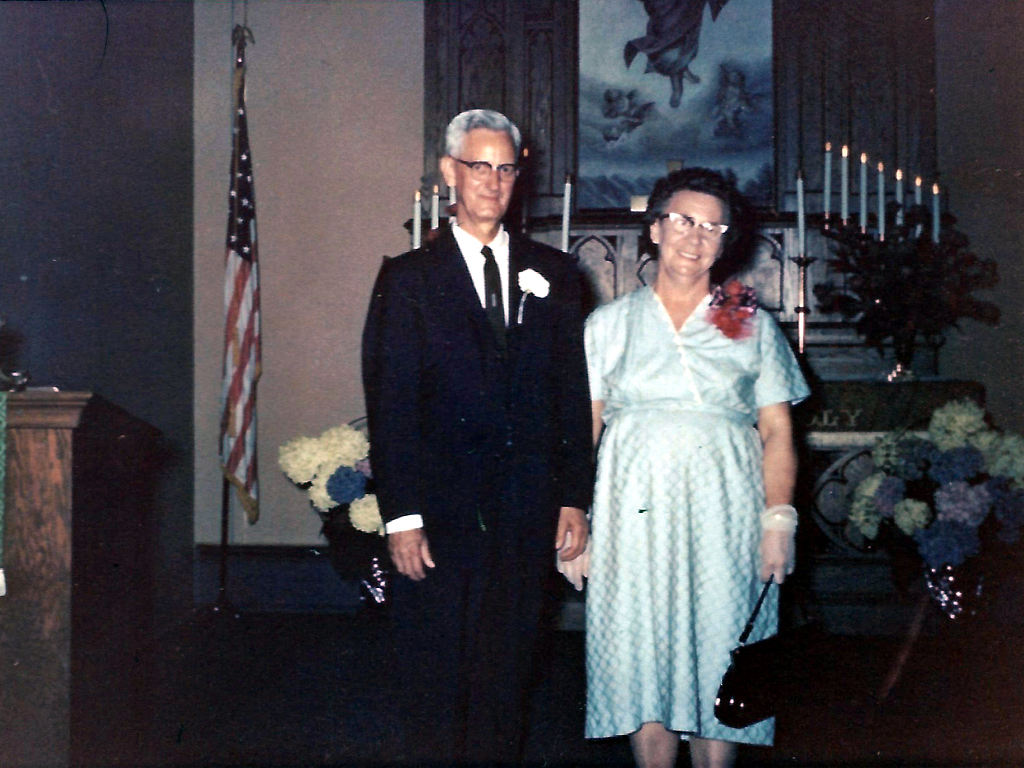
St. Peter's Lutheran Church, c. 1960s
Throughout his years at Campbell Hill, Harry served the Southern Illinois District of the Lutheran Church–Missouri Synod well beyond his parish: Circuit Counselor, Secretary of the Board of Missions, Chairman of the Social Welfare Committee, Pastoral Advisor to the LWML and LLL, District Vice President, and then District President from 1947 to 1957. After ten and a half years across his terms he asked the Convention not to put his name forward again. He contributed sermons to the Concordia Pulpit and fulfilled special assignments for the General Synod.
Despite the calls he received to serve other congregations over the decades, he declined them all. His entire active ministry — 48 years — was spent at St. Peter's, Campbell Hill.
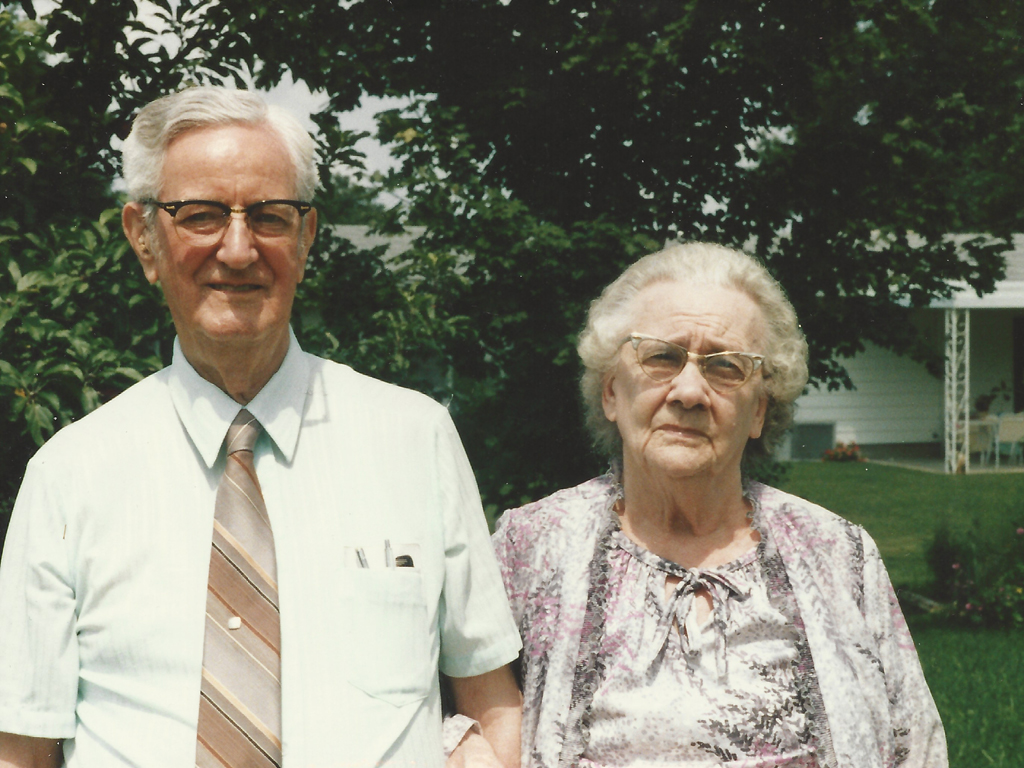
Effingham, Illinois, 1986
Harry retired from the active ministry in June 1969 and he and Alma moved to Sparta, Illinois. He continued preaching as a guest in neighboring Lutheran congregations when the need arose. In December 1972, four of their children having settled in Effingham, Harry and Alma followed them there.
Soon after arriving, Lakeland Nursing Center asked him to conduct Sunday morning worship services. He wrote of what that ministry became:
Alma and I are grateful to the Lord for granting us this opportunity to serve Him in this manner. This service is a voluntary service. The fact that Alma has been able to go with me to LNC regularly on Sunday morning has been an inspiration to me, and is deeply appreciated by the 60 to 70 residents who attend the services.
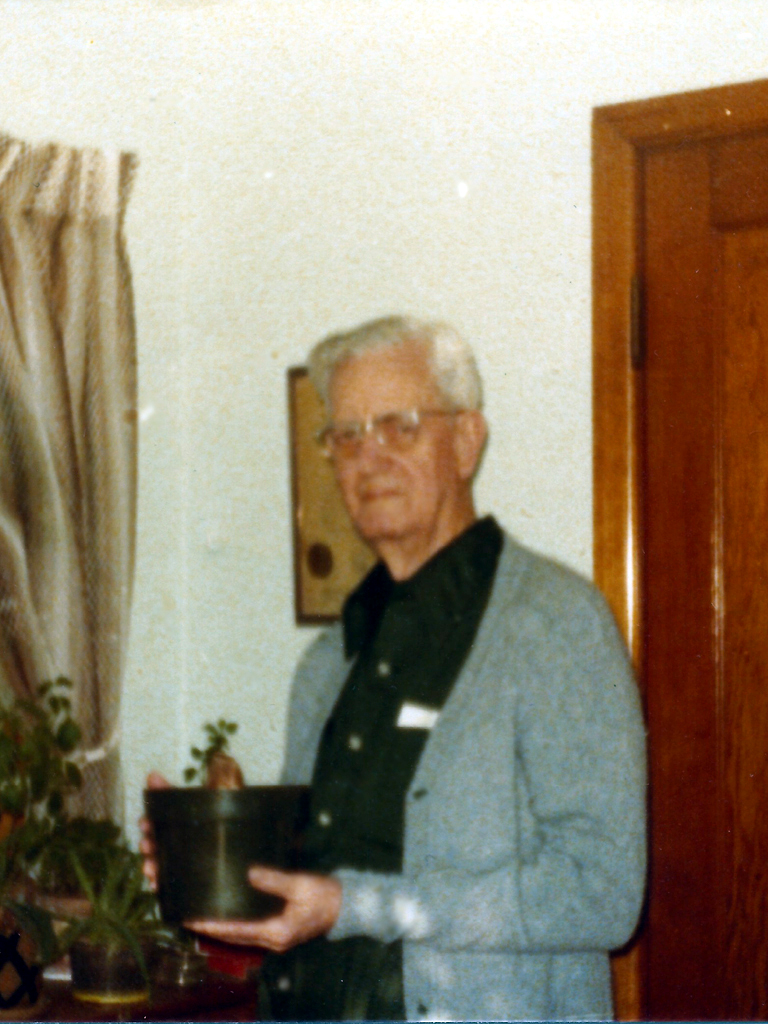
Effingham, Illinois
He conducted those services for nearly a decade. Rev. Harry C. Welp died on 20 February 1992 in Effingham, Illinois, at the age of 94, and is buried at Arborcrest Cemetery. Alma, who had been beside him from that first date in Indianapolis through the train platform at Campbell Hill to the nursing home chapel in Effingham, survived him.
- 12 Aug 1897Born in Frohna, Perry County, Missouri; son of Henry J. Welp & Regina Twenhafel
- c. 1903Enrolled at Trinity Lutheran Christian Day School, Frohna — his father the principal and teacher
- Fall 1911Entered St. Paul's College, Concordia, Missouri
- 1917Graduated St. Paul's; entered Concordia Seminary, St. Louis (~600 students, 11 professors)
- Summer 1919Worked at Stutz Automobile Factory, Indianapolis; met Alma Rafert
- 1919–1920Vicarage at St. John Lutheran Church, Baldwin, Illinois
- Summer 1920Worked at Pres-O-Lite Company, Indianapolis
- 1921Graduated Concordia Seminary — class of 84
- 26 Jun 1921Ordained and installed as pastor, St. Peter's, Campbell Hill — by Rev. J. Lohrman, Baldwin, IL
- Labor Day 1921Reopened the Christian Day School — 18 pupils, all eight grades, sole teacher
- 12 Oct 1921Married Alma Rafert at her home in Indianapolis
- 15 Oct 1922Daughter Phyllis born — while Harry was preaching
- 16 Aug 1924Daughter Marian born
- 7 Mar 1926Son Paul born
- 18 Dec 1926Paul died of Secondary Meningitis — age 9 months
- 1927Daughter Doris born
- 10 Feb 1930Marian died of bronchial pneumonia — age 5
- 1930Daughter Vera born
- 1932Daughter Ruth born
- 1937School enrollment reaches 59; Arnold Schneider engaged as second teacher ($25/month & board)
- 1937Son Thomas born
- 1941Confirmed daughter Doris and her class
- 1944–45Asked by the U.S. government to preach for German POWs at Camp Pomona, Jackson County
- 1947–1957District President, Southern Illinois District, LCMS — 10½ years; declined to stand again
- 13 Nov 1951Tornado strikes Campbell Hill — 15 homes flattened, 150 homeless; Harry stays with a trapped woman until her rescue
- Jun 1969Retired after 48 years at St. Peter's
- 1969Retired to Sparta, Illinois; continued guest preaching
- Dec 1972Relocated to Effingham, Illinois
- c. 1973–83Conducted weekly Sunday worship at Lakeland Nursing Center, Effingham
- 20 Feb 1992Died in Effingham, age 94; buried at Arborcrest Cemetery